Posts

Ghost malls

Image
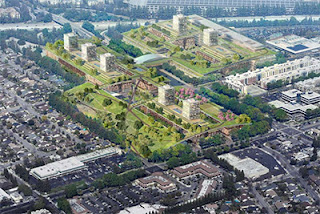
Several years ago, we went to my wife's friend's wedding at Vallco Mall in Cupertino. To our surprise, the parking lot was empty and many of the doors were barred. We finally found an open entrance and walked in. The lights were half on and there were only several people wandering around during a time where nearby Valley Fair Mall was absolutely teeming with people. The sound of a heavy door closing shut somewhere in the mall echoed through the otherwise quiet halls. Only four businesses were open in this giant mall: A large Chinese restaurant where the wedding was held at, a movie theater, a Cold Stone, and a random eyeglasses store. It was downright eerie, like if you walk around Times Square in the late afternoon and you only see five or six people walking around. Did the zombie apocalypse just begin? No, it turns out Vallco was a victim of several anchor stores closing up, turning it into what's known as a ghost mall. Developers had purchased the nearly vacant mall in...

2D vs 3D

Image
Everyone knows the difference between 2D and 3D. When watching The Simpsons, people can tell when they're seeing 2D Homer vs 3D Homer . Most people can also figure out 2D. People can pull up a map and reasonably figure out where they are in relation to nearby towns and geographic features. Likewise, most people can draw simple maps for others to follow. But when 3D enters the picture, for some reason, some people, even those that have power to deny building projects based on architectural drawings, have difficulty visualizing and presenting unbuilt space in three dimensions. In 3D perspectives, heights drop off with distance. Intuitively, we know this. When we see a building with a flat roof run into the distance, the roof line runs down as if shrinking, even though we know from experience that the roof line is flat. If captured on paper, the lines run down toward what's called "vanishing points" on the horizon. In architecture, we frequently draw building elevati...

Most Bay Area cities laughingly behind on their own housing goals

Have you ever made goals that you eventually realize it would take several lifetimes to accomplish? Perhaps some New Year resolutions you followed stringently for about a month before the effort somehow fizzled away? You can maybe take comfort that the city of Concord had set a 22 year housing goal that would take 966 years to achieve, if the current housing trend continues. Unfortunately, when cities fail this spectacularly, it adversely affects tens of thousands to millions of people. The San Francisco Chronicle reports how many Bay Area cities are lagging far behind their targeted housing growth by 2040 and includes a link to a handy map by the Metropolitan Transportation Commission. The housing goals are set by a governmental agency called the Association of Bay Area Governments and the projections are based on housing growth between 2010 and 2017. Every single county is over-performing its job forecast, some by massive amounts, and every single county is under-performing its...

Appealing to nature

Image
We've all heard it. We've probably all bought into it at least several times as well. Natural is good. Buy the all natural product. Naturally grown food is better. Don't clean with that, there are chemicals in it! Of course, some of those ideas may be right sometimes, but using that reason in itself is fallacious. The mentality is so pervasive there is a logical fallacy specifically termed appeal to nature . This fallacy also occasionally bleeds into building construction, primarily choosing planning commissions and design review boards as its preferred medium. I have, myself, fallen prey to this mentality when I was younger, just out of architecture school. I was really into architecture conveying the truth. I still believe in this as far as ideas like spatial transparency where using hierarchical methodologies, one can, from the exterior, tell what spaces within a building are served for which purposes. But where nature is concerned, I was aghast to learn that, at least...

Getting more expensive by trying to be more affordable

Image
Conventional wisdom says that less square footage in a house means a more affordable house. Building a 2,000 square foot house should sell for more than an 1,800 square foot house on the same lot. This convention is not necessarily true, but it doesn't stop planning commission members from utilizing this logic to force smaller square footage homes in effort to bring prices down. Not all square feet are created equal. For example, one square foot of house on a main level is substantially more valuable than one square foot of house on a basement level. Basements, even with window wells, are dark and cold spaces that tend to not be as pleasant to be in compared to above ground living which has much more opportunity for light. Two story houses achieve higher density, therefore can achieve lower costs per square foot compared to a single family home. Land in the Bay Area is expensive. A house that takes up more land will cost more for the house you get. At a planning commission ...

Little Pink House

Image
Official movie poster The movie Little Pink House was released last Friday (in Berkeley at least) in what should be one of the most important films this year. It is an excellent, gut-wrenching film about someone just like you or me, with a strong performance by lead actress Catherine Keener. It covers Susette Kelo and the Institute for Justice 's fight against eminent domain abuse by New London, a town in Connecticut. Eminent domain is a legal process whereupon a government may take private property, with just compensation, for public use. However, jurisdictions have abused this government power to seize private property for the benefit of other private parties. These typically includes taking the homes of those less well off and giving them to wealthy interests such as major developers or corporations. Even Constitutionally compliant seizures have resulted in abuse such as lowballing appraisals to the landowners. In California's controversial high speed rail projec...

The artist exodus

Image
The San Francisco Chronicle published an article  about artists fleeing San Francisco due to its high cost of living, as part of its Grass is Greener series. It chronicles several artists moving to other cities such as Seattle and Los Angeles to escape the high rents in San Francisco. Art is extremely important. Sure, some art, maybe even most art, is just eye-candy, to simply stimulate the visual senses, not that there's anything wrong with that. But the most profound art unlocks hidden insights into our own character, expresses the perspectives of the artist, provides commentary on society, or locks in historical context for future generations. Unfortunately, having a roof over one's head is more important than art, and the art scene is being pushed out by this simple truth. When the housing supply is restricted to the whims of city planners and no growth neighbors, land costs go up and things less important than this basic necessity start to get pushed out. Murals i...