Posts

Your house is too tall underground
Image
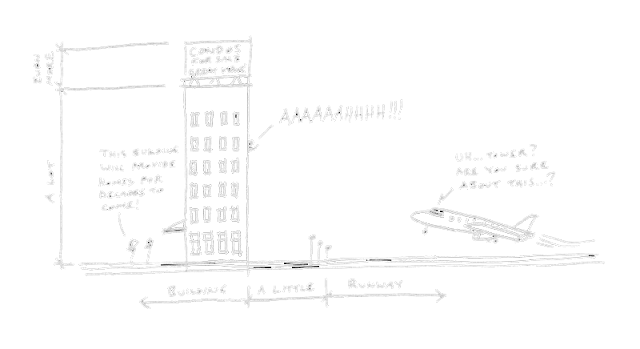
Many jurisdictions will impose height limits on houses in order to keep densities the way the elected city councils want them. Many times, it's for the livability of neighborhoods so people don't build five story condos next to single story houses. Sometimes, it's for aesthetics so people don't build townhomes in a rural setting. Occasionally, it's for pragmatic reasons so someone doesn't, say, build a tall building in front of an airport runway. Sometimes the code will measure from the finished grade to the top of a ridge or parapet wall. Other times, the code will set a limit to the midpoint between the eave and ridge. When the grades are sloped, the code often will prescribe an average or midpoint of the grades. Unfortunately, many times the code isn't perfectly clear or well defined. One of my colleagues ran into this issue with a planner. The code specified a height limit, but although it wasn't specified, these height limits are pretty mu...
Inability to get out of your own way (Part 3)

Continued from Part 2 HOW long?? Although we worked on the design for two years to gain approval from the DRB, we were always viewed as the "rookies" on the design team. The landscape architect had been with the project for years before us. And we learned that there was a local community group that had been pushing for this project for twenty years. Twenty?! I thought I had misheard the number, but she went on about how when she started the project, her kids were still in grade school and now they've gone off on their careers. Twenty years. I was still in high school then, hoping to get accepted into a good school to study architecture. Bill Clinton was the president. Tech stocks were booming as people began to discover the internet as AOL, the largest ISP, served via 56k baud modems, downloading one mp3 song in 20 minutes. No cell phones had cameras yet. I've since graduated college, earning a Bachelor of Architecture and practiced in the field for over a decad...

Inability to get out of your own way (Part 2)

Image
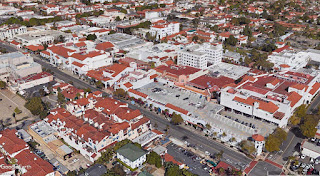
Continued from part 1 . More design inanities now from DRB Stuck with the Santa Barbara direction, we were going to make lemonade out of lemons. We decided to make some great Santa Barbara architecture, absurd as it was, and sprinkle in modern style architecture as well. No dice. We went into the design review board and were promptly shut down. The board liked the architecture independent of each other but thought the juxtaposition between them was too jarring, fixating on the gable roofs versus the flat roofs. It was a fair point. We wanted to say that we were forced into this position from the irrationality of the city and we were just trying to get  something  in there that we thought would be in the best interest of the public, but of course, that would just lead to more tension. We instead argued that the roof forms are not so much a focal point in four story architecture as they are in one to two story architecture and that as long as the vocabulary of the design i...

Inability to get out of your own way (Part 1)

Image
The fateful project In the East Bay, there lies a city that is perhaps the most crime riddled and has one of the most corrupt governments in the Bay Area. There are a few nice areas to be clear, but our project wasn't in one of those areas. In fact, while a senior housing building was going up next door to our project, one of the construction crews was held up at gun point. We did a site visit once, but opted not to stay long and our future site investigations were done on Google Maps. The civil engineer was reluctant to send a survey crew out to the area past a certain time due to crime concerns. But boy, did the site have potential. It was next to a freeway with a small creek running through it. There was a BART station nearby though it would be a bit of a hike. On top of all that, there was extensive history to the site. Around 1906, two Japanese families owned much of the parcel and grew flowers in some fields and greenhouses for a living. During this time, there was much...

Ghost malls

Image
Several years ago, we went to my wife's friend's wedding at Vallco Mall in Cupertino. To our surprise, the parking lot was empty and many of the doors were barred. We finally found an open entrance and walked in. The lights were half on and there were only several people wandering around during a time where nearby Valley Fair Mall was absolutely teeming with people. The sound of a heavy door closing shut somewhere in the mall echoed through the otherwise quiet halls. Only four businesses were open in this giant mall: A large Chinese restaurant where the wedding was held at, a movie theater, a Cold Stone, and a random eyeglasses store. It was downright eerie, like if you walk around Times Square in the late afternoon and you only see five or six people walking around. Did the zombie apocalypse just begin? No, it turns out Vallco was a victim of several anchor stores closing up, turning it into what's known as a ghost mall. Developers had purchased the nearly vacant mall in...

2D vs 3D

Image
Everyone knows the difference between 2D and 3D. When watching The Simpsons, people can tell when they're seeing 2D Homer vs 3D Homer . Most people can also figure out 2D. People can pull up a map and reasonably figure out where they are in relation to nearby towns and geographic features. Likewise, most people can draw simple maps for others to follow. But when 3D enters the picture, for some reason, some people, even those that have power to deny building projects based on architectural drawings, have difficulty visualizing and presenting unbuilt space in three dimensions. In 3D perspectives, heights drop off with distance. Intuitively, we know this. When we see a building with a flat roof run into the distance, the roof line runs down as if shrinking, even though we know from experience that the roof line is flat. If captured on paper, the lines run down toward what's called "vanishing points" on the horizon. In architecture, we frequently draw building elevati...

Most Bay Area cities laughingly behind on their own housing goals

Have you ever made goals that you eventually realize it would take several lifetimes to accomplish? Perhaps some New Year resolutions you followed stringently for about a month before the effort somehow fizzled away? You can maybe take comfort that the city of Concord had set a 22 year housing goal that would take 966 years to achieve, if the current housing trend continues. Unfortunately, when cities fail this spectacularly, it adversely affects tens of thousands to millions of people. The San Francisco Chronicle reports how many Bay Area cities are lagging far behind their targeted housing growth by 2040 and includes a link to a handy map by the Metropolitan Transportation Commission. The housing goals are set by a governmental agency called the Association of Bay Area Governments and the projections are based on housing growth between 2010 and 2017. Every single county is over-performing its job forecast, some by massive amounts, and every single county is under-performing its...